Krav Maga Scenarios 04.06.13

No scenario this week, strictly speaking. In preparation for the seminar, we’re going to be training…
Krav Maga Program

Combatives for Defenses Against Hand Gun Threats


Saturday, 4/6, 8:30AM

Post requests for future scenarios to the comments below!


Share

Krav Maga Scenarios 01.19.13

This week’s scenario will be…
Your finest JC Penney tux

Self-Defense and Fighting in
Snazzy Everyday Attire.

We won’t be doing anything overly strenuous, so don’t worry about getting your satin cummerbund all sweaty. You needn’t wear your finest JC Penney tuxedo, just something that’s not comfortable training attire. Whatever you wear to work is fine—unless you day-trade from home in your underwear.

Saturday, 1/19, 8:30AM

Post requests for future scenarios to the comments below!


Share

Krav Maga Scenarios 12.01.12

Tight Spaces
This week’s scenario will be…

Combatives and Strategies for Fighting in Close Quarters

Saturday, 12/1, 8:30AM

Post requests for future scenarios to the comments below!


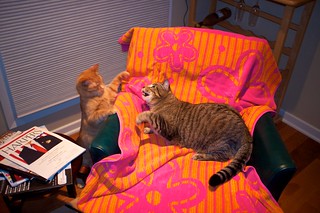
Photo credit: billiballa, on Flickr


Share

Krav Maga Scenarios 11.03.12


This week’s scenario will be…

Developing Your “When”:
Combatives for Preemptive Self-Defense

Check out this post for more details.

Saturday, 11/3, 8:30AM

Post requests for future scenarios to the comments below!


Share

To Punch the Impossible Punch

Patrick let me borrow the keys to the blog, so while waiting for Part Deux of his training manual, I’ve written up some notes on generating more power in our strikes and blocks. They hold true (if they hold true) for Kenpo and Krav. —Josh

If you can “work smarter, not harder,” does the same hold true for punching? Can you punch smarter, therefore harder? I say that you can, but before we know for sure, let’s consider what it means to punch smarter.

In Kenpo we learn there are four elements of power (and this will be on the test, black belt candidates): speed, backup mass, torque, accuracy. With the possible exception of backup mass (about which more in a second), each of us has the ability to improve on our power.

As baseball players obsess about bat speed and golfers obsess about club speed, we could all stand an examination of our fist speed. If you don’t believe me (or David Ortiz or Tiger Woods), how about my high school physics teacher, Mr. Hertz? (Yes, I actually had a physics teacher named Hertz.) It was from him I learned Newton’s Second Law of Motion: : force equals mass times acceleration:

A related equation: Kinetic energy equals one half times the mass of the object times the square of the speed of the object.

Force derives from acceleration, energy derives from velocity: however you define power, it is dependent on, even inextricably tied to, speed.

So, how do you punch faster? Listen to Bas Rutten. Remember how he implores us to make a combination faster by imagining it faster: Bum-bum-bum-bum! Condensing the time between punches also makes each individual punch faster, therefore stronger. Bruce Lee, among other fighters, also counseled staying loose, tensing only at the instant of throwing the punch (the same holds true for blocking). This is invaluable advice. The tighter you are, the more you clench the muscles that pull back your arm (mostly biceps), as well as the muscles that extend your arm (mostly triceps). You are literally fighting yourself. The next time you do shoulder tag, focus on keeping your arm and shoulder muscles poised but loose. Note how you swat away with ease and contempt your partner’s useless efforts to score off you, while your own finger tips cut the air like flesh-colored ginsu knives.

As to backup mass, I wouldn’t suggest anyone put on weight, especially—well, you know who I mean. But we could do more with the weight we have, which is why I’ll consider backup mass along with torque. I don’t care how massive your guns are, they are only a small percentage of your body weight. When your punch carries behind it the force and weight of your entire body, it will be massively more powerful than a mere spasm of the triceps muscle. Again, listen to Bas: twist your body, keep your feet on the ground. Think of your jab as a full-body strike, extending from your toes, through the arch of your foot, up your back calf muscle (right leg for a left jab), your hamstring, quads, and glutes, your obliques and lats, your pecs, before even getting to the muscles of the shoulders and arms. If all act in concert and at the same time, you are bringing a whole heck of a lot of backup mass and torque to a simple jab.

Here’s another way to think about it. Ancient architects knew that to keep a structure standing—a cathedral, a bridge, a viaduct, etc.—they had to direct the force of its weight, via arches and buttresses, laterally and into the ground. Hang on a sec:


See? Why should force not run the opposite way, as well, from the ground, through your body and out your fist?

Try this experiment: stand in your fighting stance and try to push with one hand a tombstone shield held by your opponent. Push as hard as you can. What posture do you take? You drive through your legs, twist your body, and lean into the pad. With some modifications to avoid losing balance or speed, that should be your punch.

Last, accuracy. I would say last and least, but if you can’t hit the target, or can’t hit it cleanly, your speed, mass, and torque will be for naught. When hitting pads, try to hit them squarely—straight out, straight back–with no “chipping” or “swimming” motion. When using your combatives, remember to strike sensitive targets, not solid bone. And punch with the first two knuckles of your fist, which are not only stronger, but a more direct extension of your forearm than the smaller outer knuckles. (This can sometimes be hard to maintain in the heat of battle; turn your fist vertical if you find yourself leading with your weaker knuckles. With this “thrust punch,” the stronger knuckles will usually connect first.)

One closing piece of advice is to remember to connect with the punch at near-to-full extension (while avoiding the painful result of hyperextension). Full extension allows the fist to generate greater momentum (mass times velocity, says Mr. Hertz) before impact, but it’s also good body mechanics. If your push-up is easiest at full extension (and hardest near the ground), your punch should be stronger there too. Too often, we hit the pad at close range and just push it away rather than connect with full impact.

Of course, you can train physically to punch stronger (push-ups and rotational core exercises being obvious ways), but some of the strongest hitters I’ve known have been some of the slightest people. Power is about mechanics as much as it is about strength. These observations come from ten-plus years of training at MacDonald’s Academy in Kenpo and Krav, my trials and errors patiently endured and corrected by Brian (more trials than Perry Mason, more errors than the ‘62 Mets). Like anything new, some of these tips may feel awkward at first, but drill them—on the mitts and pads, in the mirror while shadow boxing, during shoulder tag. Adjust them to make them work for you. And let me know if punching smarter, or at least punching with a lot of intrusive, annoying thoughts and corrections in your head, has helped you to punch harder.

Have a great long weekend, everybody! I’ll post again when something occurs to me, or when Patrick allows it, whichever comes second.

Share

Self-Defense with Jo

Perhaps the funniest part of these videos is that the technical details are actually pretty good. But it’s the execution that will crack you up!

The rest of Jo Bonten’s instructional videos can be seen here.

DON’T LET YOU TO BE FAKED!

Share

GTG for Krav Maga

I-40 Lens Grease
In an old post on practice and repetition, I mentioned a Pavel Tsatsouline method called Grease the Groove and gave some suggestions of what types of skills are well-suited to this type of training. I’d like to expand the scope of that original post a bit and discuss more of the how and why of GTG and where it can intersect with becoming a better Krav Maga practitioner.

The GTG method is explained in Pavel’s book The Naked Warrior, which focuses on developing maximal strength with bodyweight exercises through manipulations of tension and leverages. Recall from the practice post that the central concept of GTG is:

Specificity + frequent practice = success

Here’s the simplest possible example of how to use GTG: Set up a pull-up bar in your home or office (or select a proper structural support beam out back in the warehouse…). Every time you walk past it, do a sub-maximal set of pull-ups. Over the course of the day, you will easily rack up A LOT of pull-ups. Two of the biggest advantages of this approach are that you improve quickly due to the training volume and frequency, and you don’t need a dedicated workout time and place.

This seems straightforward enough, but there are right and wrong ways of employing GTG to maximize the success of your efforts.

Keep It Greasy »

Share

The Groin Strike Is Not Just a Punchline

Youch.
Groin strikes are a bit of a running gag about Krav Maga. It may seem we have a fixation, and, admittedly, there are few things funnier than seeing someone biffed in the crotch.

Juvenile giggling aside, there’s a reason why groin strikes are barred from combat sports: they’re fight enders. Even with protection, a strike to the groin can completely incapacitate the strongest of fighters. Doubt it? Seen this?
Click here for cringe inducement »

Share

Fight Endurance Class

KMW_001 The new Fight Endurance class begins today, Tuesday Jan 31. This weekly class will be held at 7:30pm in Training Room 2.

All participants must be Krav Maga Advanced students or otherwise approved by the instructor.

The instructor is Tim Burke. Says Tim:

The goal of the class is to increase the strength and endurance of every participant as it relates to “stand up” fighting combinations. We will build on the basic Bas Rutten workout combinations and incorporate Muay Thai pads. Different from our normal Krav Maga training classes where we might spend half the time on conditioning and half the time on technique, this class will be geared more towards dedicated conditioning with longer periods of rest and recovery. The class will have very little instruction and focus more on punching and kicking stronger, faster, and longer.

Classes will be limited to 10 participants due to space and equipment restraints and will be on a first-come, first-served basis via sign-up at the school. (See the dry erase board by the stairs to Training Room 2).

Share

October 2011 Krav Maga Syllabus

The October 2011 syllabus is subject to change. This post will be updated throughout the month.

Questions? Post to the comments!

View the Syllabus »

Share